Leading Charité Berlin Neurosurgeon Professor Peter Vajkoczy Highlights Treatable Causes of Tinnitus
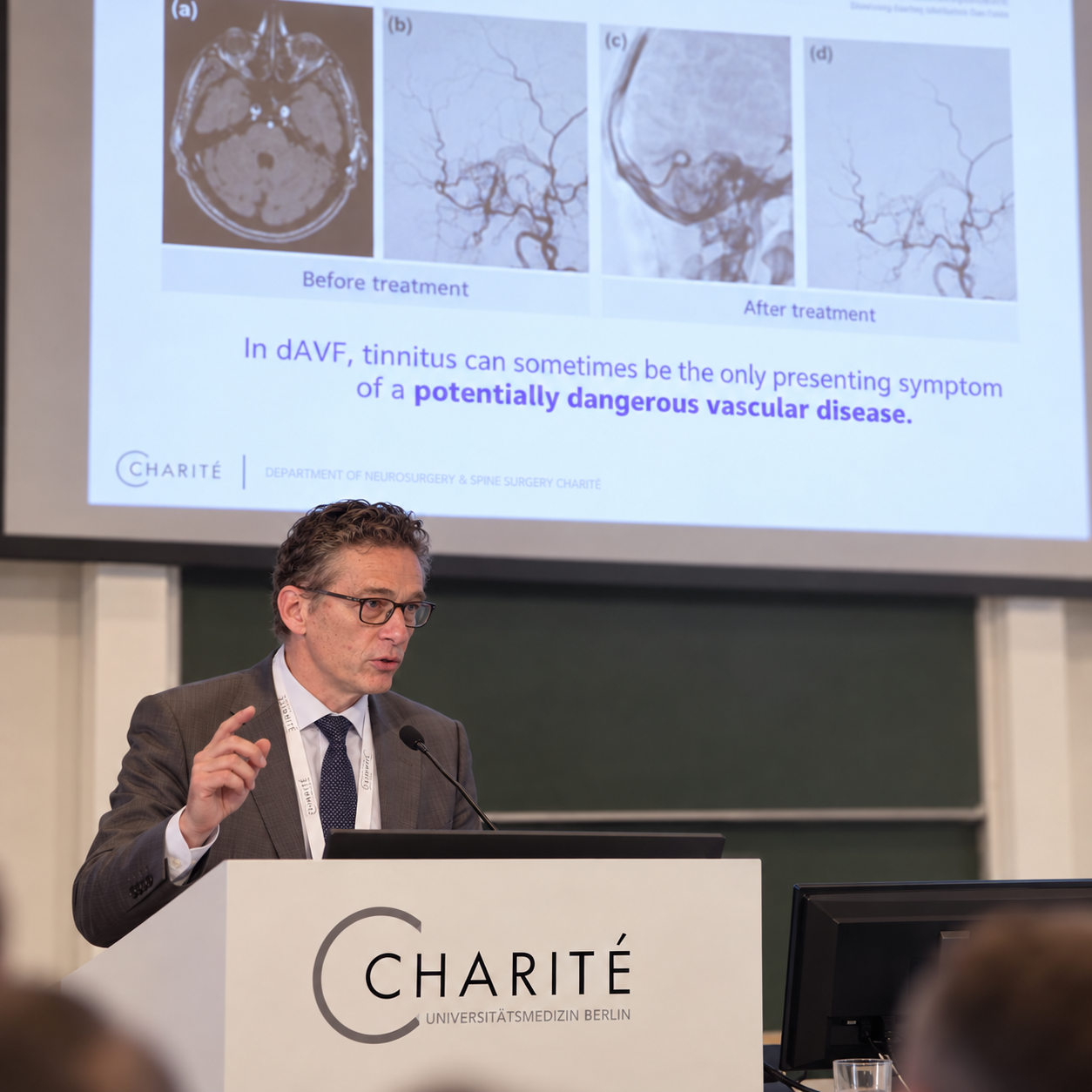
Professor Peter Vajkoczy, Director of the Department of Neurosurgery at Charité – Universitätsmedizin Berlin, brought the perspective of one of the world’s foremost neurosurgical centres to tinnitus at the 20th Tinnitus Research Initiative Conference in Berlin.
Professor Vajkoczy is a world-renowned neurosurgeon and a major international figure in contemporary neurosurgery. He leads Charité’s Department of Neurosurgery, part of a service that Charité describes as the largest neurosurgical clinic in Europe, performing more than 6,000 operations annually. His Charité research profile currently lists more than 800 scientific publications.
The international standing of the centre he leads is equally notable. Charité’s Department of Neurosurgery was ranked third worldwide for neurosurgery in the Newsweek/Statista World’s Best Specialized Hospitals 2024 ranking. Charité itself has repeatedly ranked among the world’s leading university hospitals and was ranked the leading hospital in Europe in Newsweek’s 2024 overall hospital ranking.
Against this background, Professor Vajkoczy’s contribution to the tinnitus meeting was particularly significant.
His presentation highlighted an important clinical message: although tinnitus is not generally a surgical condition, in selected patients it can be associated with an identifiable and potentially treatable underlying cause. Professor Vajkoczy discussed three areas of particular relevance to neurosurgery: neurovascular compression, tumours and vascular-flow abnormalities.
He explained that neurovascular compression may be relevant in carefully selected patients with a characteristic presentation, while in patients with tumours such as vestibular schwannoma, treatment priorities extend beyond tinnitus to tumour control, preservation of facial nerve and hearing function, and brainstem safety. Tinnitus may improve, but expectations need to remain realistic.
Particular attention was given to pulsatile tinnitus and vascular causes. Professor Vajkoczy explained how conditions such as dural arteriovenous fistulas and venous sinus stenosis can alter vascular flow and generate pulsatile tinnitus. In appropriately selected cases, correcting the underlying vascular abnormality through endovascular or surgical treatment can result in substantial improvement or even resolution of the tinnitus.
The broader message was one of careful diagnosis and patient selection: before considering treatment, it is important to ask whether there is an identifiable underlying cause and, where there is, whether treating that cause can also address the tinnitus.
Professor Vajkoczy’s contribution in Berlin demonstrated why tinnitus benefits from engagement with expertise well beyond the traditional boundaries of the field. Bringing a world-renowned neurosurgeon and the experience of a major international neurosurgical centre into the tinnitus conversation opens opportunities for dialogue across neurosurgery, neuroscience, otology, audiology and other disciplines.
This breadth of expertise and interdisciplinary thinking will continue at the World Tinnitus Congress and International Tinnitus Seminar in London, 30 June–2 July 2027.