From Competition to Convergence: China, the United States, and the Future of Global Tinnitus Research
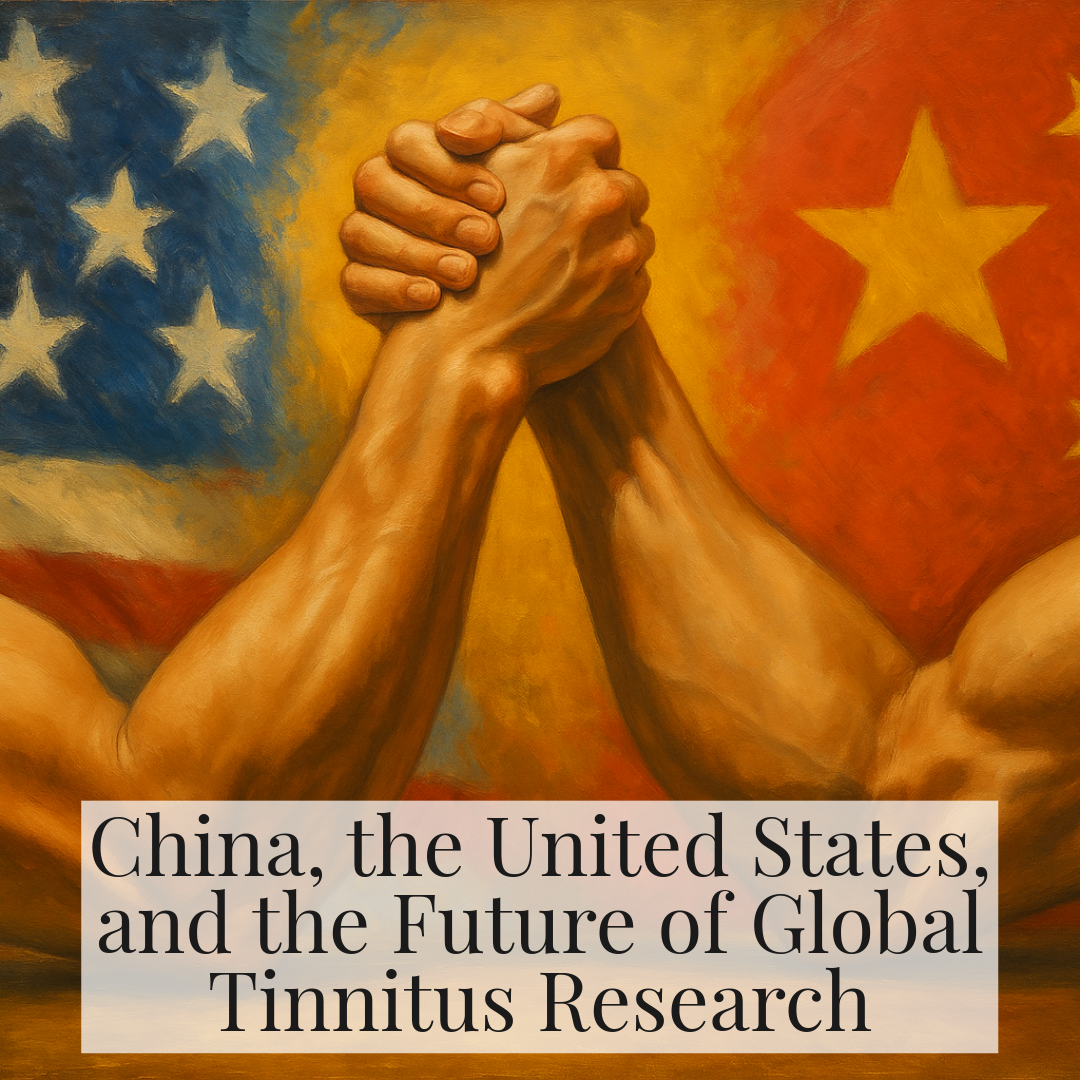
As tinnitus research output continues to expand, an early pattern of competition between China and the United States is becoming increasingly visible. Together, the two countries account for more than forty percent of global tinnitus publications. While this concentration of research leadership raises questions about rivalry and influence, evidence suggests that mutual dependence on data, methods, and conceptual frameworks is likely to reshape the landscape toward collaboration rather than sustained competition.
China and the United States bring distinct but complementary strengths to tinnitus research. Chinese studies have been particularly influential in vascular, structural, and neuroimaging-driven approaches. High-volume clinical centres and advanced imaging capabilities have enabled detailed exploration of venous sinus abnormalities, arterial contributors, and surgically treatable tinnitus subtypes. These contributions have expanded the boundaries of what is considered diagnosable and, in some cases, curable tinnitus.
In contrast, the United States has played a leading role in population-based research, stepped-care models, digital therapeutics, and psychological intervention frameworks. Large healthcare systems, including veteran services, have generated extensive longitudinal datasets linking tinnitus with mental health, sleep disturbance, and functional outcomes. This work has shaped pragmatic, scalable care models focused on distress reduction and quality of life.
At first glance, these trajectories suggest parallel and potentially competitive research agendas. However, closer examination reveals growing interdependence. Mechanistic insights from Chinese vascular and neuroimaging studies require validation across diverse populations and service contexts, many of which are provided by U.S. datasets. Conversely, behavioural and digital interventions developed in the United States increasingly rely on mechanistic stratification informed by neuroscience and imaging advances emerging from China and Europe.
Methodological convergence is already evident. Machine-learning approaches, network-based brain models, and precision-oriented frameworks are being adopted across both research cultures. Citation patterns increasingly show cross-referencing rather than insular scholarship, indicating that progress in one system depends on evidence generated in the other.
Importantly, tinnitus itself resists national ownership. Its heterogeneity demands large, diverse datasets and interdisciplinary perspectives. No single country can fully characterise its mechanisms, predict treatment response, or develop universally effective interventions in isolation. Early competition may accelerate output, but long-term progress depends on integration.
The likely future is therefore not one of dominance, but of convergence. Shared standards for measurement, collaborative trials, and cross-national data synthesis will increasingly shape tinnitus research. International conferences and consortia provide the infrastructure through which this shift can occur, transforming early rivalry into productive interdependence.
In this evolving landscape, China and the United States function less as competitors and more as anchor nodes in a global research network. Their interaction will play a decisive role in determining whether tinnitus research advances as a fragmented race or as a coordinated effort toward more precise, humane, and effective care.
Citation
Aazh H. Tinnitus Is Waking Up the Dragon: Where Ancient Culture Meets the Frontier of Brain and Vascular Science. Annual Tinnitus Report, Volume 1, 2026, pp. 9–16.
Click here to read the PDF of this article
Click on the link below to access the full Annual Tinnitus Report 2026: https://hashirtinnitusclinic.com/news/annual-tinnitus-report/