Don McFerran on the Tinnitus Field: Progress, Gaps, and the Path Forward
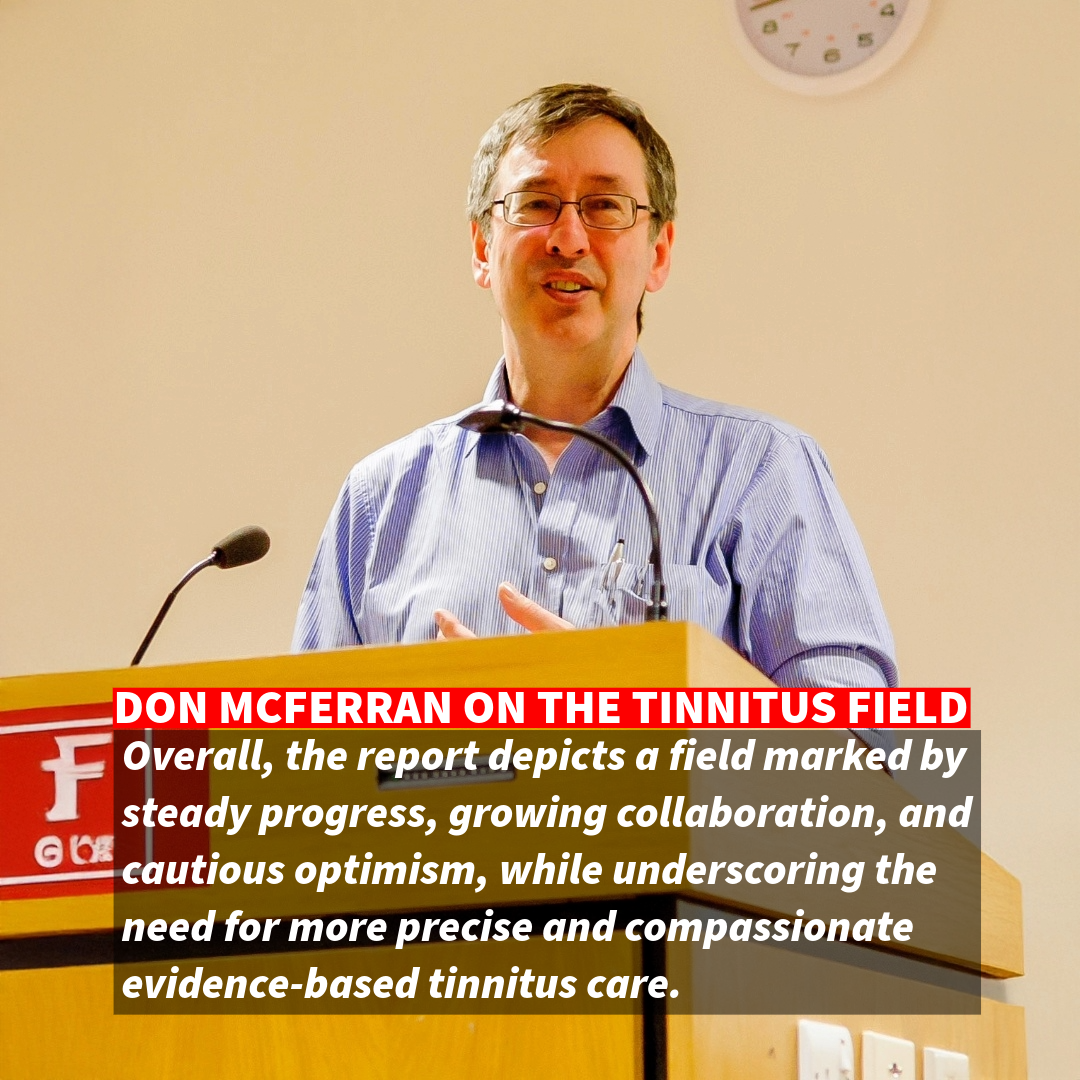
The Annual Tinnitus Report 2026 opens with an invited commentary by Don McFerran, offering a reflective overview of the field at a moment of steady progress and growing international collaboration. Written as a personal perspective rather than a comprehensive summary, the commentary situates the report within the broader trajectory of tinnitus research and care, while drawing attention to key trends, strengths, and unresolved challenges.
McFerran begins by emphasising the scale and ambition of the Annual Tinnitus Report. Produced for release during National Tinnitus Awareness Week in February 2026, the report synthesises a substantial body of global research published over the preceding year. It reflects a field that is no longer fragmented or marginal, but increasingly organised, productive, and internationally connected. Major scientific meetings, including the World Tinnitus Congress, the Tinnitus Research Initiative Conference, and the International Conference on Hyperacusis and Misophonia, are highlighted as important engines of collective progress and exchange.
The commentary draws on a detailed bibliometric analysis underpinning the report. A PubMed search identified 502 tinnitus-focused publications between November 2024 and October 2025, with 446 meeting eligibility criteria for geographic and thematic analysis. Research output remains unevenly distributed, with China and the United States leading publication volume, followed by a second tier of countries including Germany, the United Kingdom, India, and several European and Asia-Pacific nations. A relatively small number of journals continue to publish a disproportionate share of tinnitus research, shaping discourse and visibility within the field.
Six dominant research themes are identified. Epidemiology and population-based studies account for the largest proportion of publications, reflecting sustained interest in prevalence, risk factors, and comorbidities. Clinical interventions form the second largest category, encompassing CBT, digital therapeutics, hearing technologies, neuromodulation, pharmacological trials, and multimodal approaches. Pulsatile and structural tinnitus, brain and neural mechanisms, and measurement and prediction studies together form a substantial middle tier, while basic auditory and cellular models represent a smaller but strategically important component of the literature.
In reviewing treatment outcomes, McFerran underscores a key reality of contemporary tinnitus care: the most consistent benefits relate to reduced distress and improved coping rather than elimination of the tinnitus percept itself. Evidence supports the effectiveness of CBT, digital therapeutics, hearing aids, cochlear implants, and integrated stepped-care services, particularly when interventions are targeted to clearly defined subgroups. Pharmacological trials, by contrast, continue to yield largely disappointing results.
The commentary also highlights ongoing debate around measurement science. Concerns are raised that declining use of psychoacoustic assessment risks weakening the link between tinnitus mechanisms and treatment response. At the same time, advances in imaging, personalised sound-based therapies, and data-driven approaches suggest that more precise and stratified assessment frameworks may be approaching clinical relevance.
Notably, the commentary recognises the importance of lived experience. The inclusion of artwork by Eleanor Ponté is presented as a reminder that tinnitus is not solely a clinical or scientific phenomenon, but an emotional and existential one. This integration of human perspective reinforces the report’s broader message: progress in tinnitus research must ultimately be judged by its impact on people’s lives.
Overall, McFerran characterises the tinnitus field as one of cautious optimism. Progress is evident, collaboration is strengthening, but the need for more precise, compassionate, and evidence-based tinnitus care remains pressing.
Citation
McFerran D. Invited Commentary: Annual Tinnitus Report 2026 Overview by Don McFerran. Annual Tinnitus Report Supplement, Volume 1, 2026, pp. 1–3.
Click here to read the PDF of this article
Click on the link below to access the full Annual Tinnitus Report 2026: https://hashirtinnitusclinic.com/news/annual-tinnitus-report/