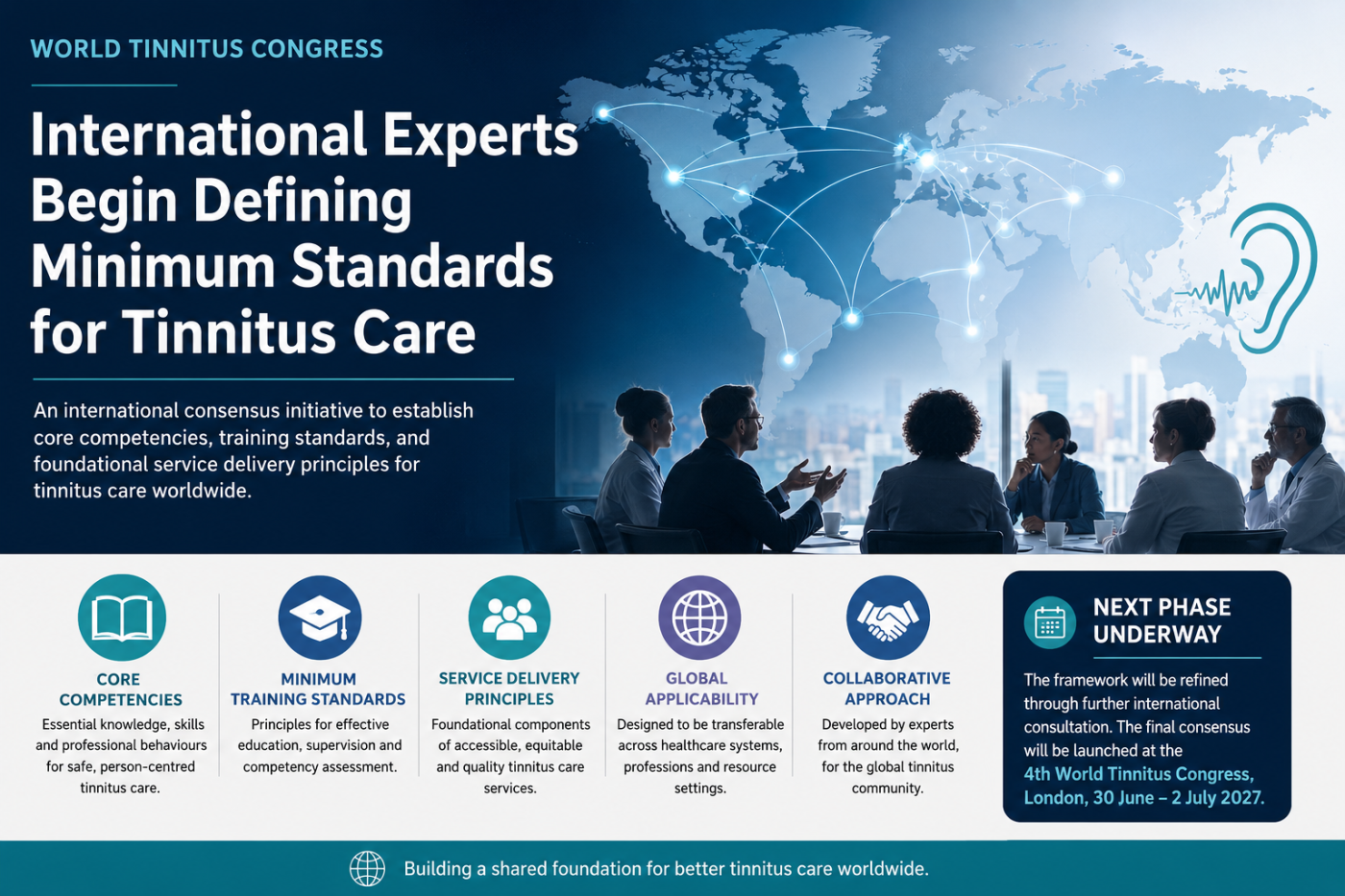
International Experts Begin Defining Minimum Standards for Tinnitus Care

The World Tinnitus Congress (WTC) has launched the first phase of an international consensus initiative aimed at defining core competencies, minimum training standards, and foundational service delivery principles for tinnitus care across healthcare systems worldwide.
The initiative, titled International Consensus on Core Competencies, Training Standards, and Service Delivery in Tinnitus Care, seeks to establish a minimum, safe, and transferable framework for tinnitus care that can be applied internationally regardless of professional background, local resources, or healthcare structure. Rather than functioning as a clinical guideline or recommending specific interventions, the project focuses on the foundational knowledge, skills, and professional behaviours required for safe, person-centred tinnitus care.
The Phase 1 Framework Document was circulated among an international group of clinicians, researchers, educators, and service leaders for initial consultation and feedback. Nineteen experts from a broad range of countries participated in the first round of discussion, including contributors from Nigeria, the United States, India, Italy, Greece, Egypt, Germany, Ireland, Belgium, Sweden, South Africa, Hungary, China, and Malaysia.
The framework generated strong overall support, with many contributors highlighting the importance of establishing internationally transferable standards that remain realistic across both high-resource and low-resource settings. Several participants noted that the framework successfully distinguishes itself from existing tinnitus guidelines by focusing on foundational competencies and service standards rather than intervention-specific recommendations.
A major theme emerging from the discussions was the importance of maintaining a clear boundary between foundational competence and profession-specific clinical protocols. Contributors broadly supported the framework’s position that decisions such as imaging pathways, hearing aid fitting procedures, or specialist psychological interventions should continue to be governed by national and professional guidelines. Instead, the consensus process focuses on shared competencies relevant across disciplines, such as explaining tinnitus in an accurate and non-alarming manner, assessing the impact of tinnitus on daily functioning, recognising psychological comorbidities, and understanding when referral or escalation is required.
Another recurring topic in the discussions was the need to define “basic tinnitus care” more explicitly. Several contributors suggested clarifying what constitutes a minimum standard service and how this may differ from specialist or advanced tinnitus care. Related discussions also addressed how the framework should apply across different healthcare systems, including primary care, community services, audiology clinics, ENT services, and multidisciplinary settings.
The issue of global applicability was strongly emphasised throughout the feedback process. Experts highlighted the importance of ensuring that the proposed competencies remain achievable in low-resource environments and do not inadvertently become dependent on specialised infrastructure or highly localised healthcare pathways. Contributors also encouraged the inclusion of cultural and linguistic adaptability, accessibility considerations, and flexibility in training methods, particularly for countries where formal supervision structures or specialist tinnitus services may be limited.
Several participants proposed that the framework should place greater emphasis on psychological safety and communication. Suggestions included recognising severe distress and suicidality, avoiding alarming or deterministic explanations, addressing misinformation, and supporting realistic expectations and shared decision-making. Others highlighted the importance of explaining tinnitus in ways that are understandable to non-medically trained patients and avoiding excessive medical jargon that may increase anxiety or confusion.
Discussions also touched on related conditions and comorbidities frequently encountered in tinnitus care. Contributors proposed making clearer reference to hyperacusis, sound tolerance problems, insomnia, somatic and musculoskeletal factors, and broader functional or physical comorbidities. Some experts suggested that the framework should explicitly acknowledge paediatric tinnitus and the need for appropriate safeguarding and specialist referral pathways in younger populations.
The proposed training standards generated significant discussion as well. While there was broad agreement regarding the importance of supervision, reflective practice, and competency-based learning, some contributors questioned whether highly standardised supervision models would be feasible internationally. Suggestions included allowing flexible equivalents such as remote mentorship, supervised case discussions, or alternative forms of experiential learning to accommodate differences in local training infrastructure.
The service delivery section also attracted constructive suggestions. Experts proposed including minimum expectations regarding documentation, continuity of care, telehealth and remote service delivery, digital access pathways, and simple quality evaluation measures that could be implemented even in low-resource settings. Several contributors also encouraged the use of practical examples to help distinguish essential minimum standards from desirable but non-essential elements.
Importantly, many contributors expressed support for the overall structure and conceptual clarity of the framework. The three-part model addressing core competencies, training standards, and minimum service delivery components was widely viewed as logical, practical, and potentially useful for clinicians, educators, professional bodies, and healthcare planners internationally.
The discussions also raised important methodological considerations regarding the consensus process itself. Suggestions included the possible use of structured Delphi methodology, iterative rounds of review, voting procedures, and consensus reporting standards to strengthen transparency and reduce the influence of dominant viewpoints within the expert group. These methodological considerations are expected to inform the next phase of the initiative.
The next stage of the project is now underway. Following the completion of the initial consultation phase, the framework document will be revised and refined in response to contributor feedback. A more detailed draft consensus document will then be developed and circulated for wider international consultation involving clinicians, researchers, educators, professional organisations, and patient representatives.
The final consensus statement is planned for launch in connection with the 4th World Tinnitus Congress, which will take place in London from 30 June to 2 July 2027.
By focusing on minimum, transferable, and person-centred standards, the initiative aims to support safer and more equitable tinnitus care globally while respecting differences in healthcare systems, professional roles, and available resources. The organisers hope that the final framework will serve as a practical reference point for workforce development, education, service planning, and quality improvement across the international tinnitus field.
Phase 1 Contributors
Contributors to the Phase 1 consultation included Gerhard Andersson (Sweden), Benjamin Böcking (Germany), Alessandra Barbara Fioretti (Italy), Haitham H. Elfarargy (Egypt), James Henry (USA), Wan Syafira Ishak (Malaysia), Vasiliki Maria Iliadou (Greece), Wafaa Kaf (USA), Hannah Keppler (Belgium), Akeem O. Lasisi (Nigeria), Christine Louw (South Africa), Sarah Michiels (Belgium), Birgit Mazurek (Germany), Molnár András (Hungary), Prashanth Prabhu (India), Arianna Di Stadio (Italy), Sven Vanneste (Ireland), Sebastian Waechter (Sweden), and Hui Wang (China).