The Ouroboros Lecture: Tinnitus, Paradox, and the Loop of Human Experience
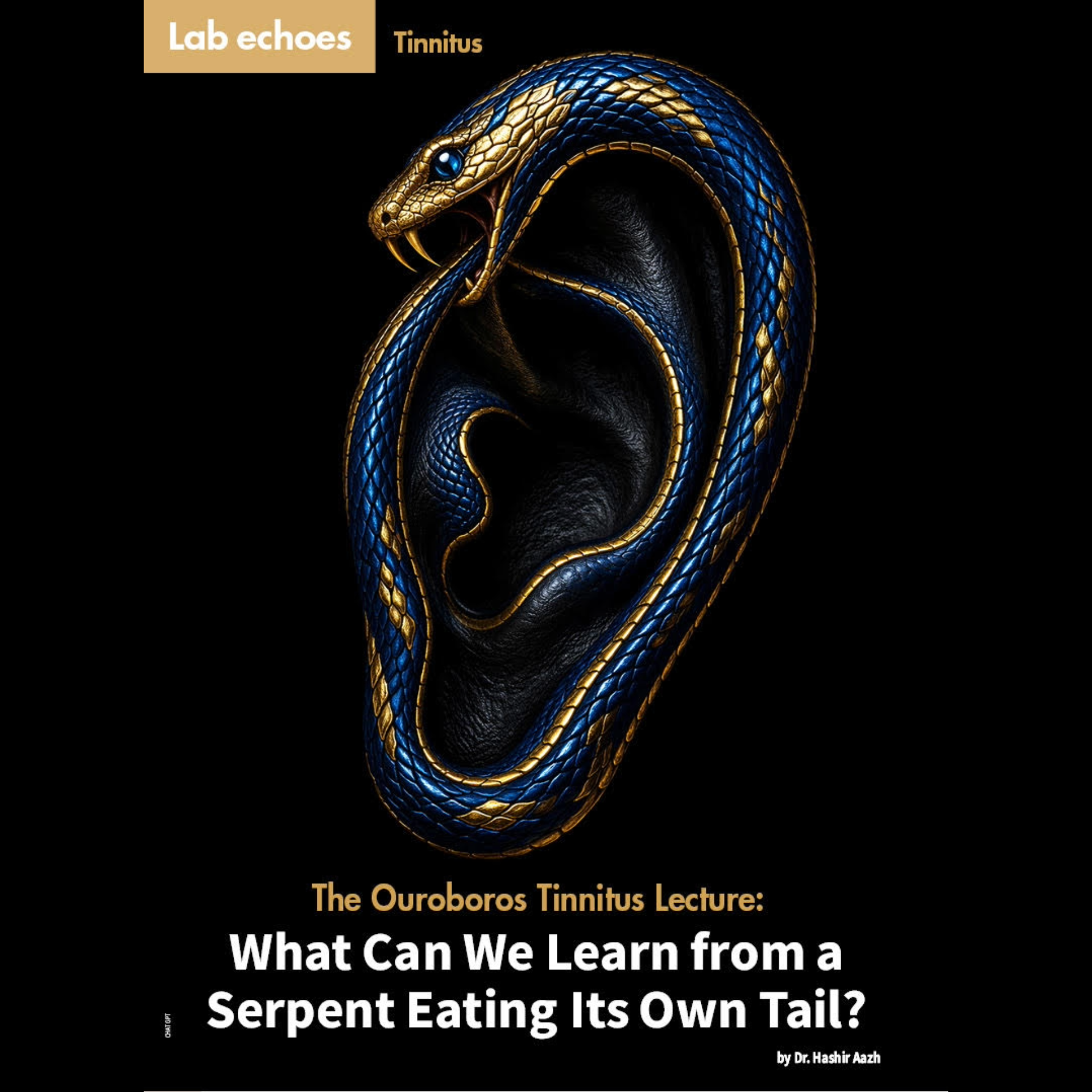
New article published in Audiology News UK (May–June 2026, pp. 28–30).
Tinnitus is often described as a sound without an external source, but this definition barely captures its complexity. Tinnitus is not only a neural signal. It is also a psychological reaction, a lived experience, and a socially shaped reality. It exists at the intersection of biology, perception, emotion, and meaning. Attempts to reduce it to a single dimension frequently fall short.
When tinnitus is viewed purely as a biological mechanism, it becomes measurable but often difficult to treat meaningfully. When understood only as a subjective complaint, it risks being dismissed, underfunded, or misunderstood. In both cases, something essential is lost.
The Ouroboros, the ancient image of a serpent eating its own tail, offers a powerful metaphor for understanding this complexity. Across philosophy, mythology, and psychology, the symbol has represented cycles, feedback, renewal, and the unity of opposites. In Jungian psychology, it reflects the process of individuation, where growth emerges through engagement with what is unresolved and recurring.
Tinnitus reflects similar dynamics. Opposing processes continuously shape one another through feedback loops. The search for silence can increase monitoring and distress, while the ability to live well despite tinnitus may reduce its prominence. Stress can heighten awareness of tinnitus, while calmness can allow it to fade into the background. These are not isolated forces. They are interconnected processes that influence one another over time.
The Ouroboros invites us to think about tinnitus not simply as a problem to eliminate, but as a system formed through interaction. Perception is never passive. Attention, emotion, stress, expectation, and meaning all influence how tinnitus is experienced, while tinnitus itself alters these same processes in return. The condition becomes shaped through recursive feedback between mind, brain, body, and environment.
This idea lies at the heart of the Ouroboros Lecture, the philosophical centrepiece of the 4th World Tinnitus Congress in London in 2027. The lecture is designed to encourage reflection on what tinnitus research can learn from these interacting and opposing processes. At a time when tinnitus science is advancing rapidly through brain imaging, computational modelling, machine learning, and auditory neuroscience, the lecture also serves as a reminder that measurable findings are not always identical to meaningful understanding.
The lived reality of tinnitus can easily disappear when research focuses only on what can be quantified. Yet subjective experience remains central to the condition itself. The Ouroboros Lecture therefore acts as a bridge between disciplines and perspectives. It may be delivered by a neuroscientist, psychologist, philosopher, clinician, or researcher, but its defining feature is insight rather than certainty.
Beginning in London in 2027, the lecture will become a permanent part of future World Tinnitus Congress meetings. Like the serpent returning to its own beginning, it symbolises a process of continual re-examination and deepening understanding. While scientific tracks explore individual aspects of tinnitus, the Ouroboros Lecture returns attention to the whole system and to the human experience formed through interaction, feedback, and change.
For the full text of “The Ouroboros Lecture: Tinnitus, Paradox, and the Loop of Human Experience” by Dr Hashir Aazh, originally published in Audiology News UK (May–June 2026, pp. 28–30), please see the PDF shared here with permission from Audiology News UK: Please click here.